Review of Vol.24
This volume concludes the Tower of Karma arc. At this point, we have definitively reached an inflection point in the series. A kind of point of no return where the main characters found their karma. The cosmic judgment that has enveloped them since the beginning of their lives and during their development. This story has been fundamentally a spiritual introspection into the idea of crime and materiality. How the characters, who outside of all normalcy, end up reaping malignant fruits originated by the atrocities they commit. These same people who are involved in their story develop a sense of rationality toward the crosses they have to carry; that sense is that of guilt. That abstraction generated by the free will of people. The conclusion of the Tower of Karma is a tragicomedy of the other person. A scenario where one laughs at the tragedy of another and the other has to experience how a happy ending awaits those who received another type of karma. But it is not only an arc where physical death occurs, but also a spiritual death is produced in some characters. I will limit myself to preparing these observations in an orderly manner given the total dynamism these events deserve.
Marco from the Abandoned Building
The volume begins with the conclusion of the battle between Caracal and Rodem, the demon of the abandoned building. Here two deaths occur: the fall of Caracal and the fall of Rodem, the shadow of Marco. A malignant energy takes possession of Marco again; the voice of his father floods his psyche. Ordering him to kill without mercy. To succumb to his bestiality. Rodem obeys. Before this encounter concludes, Leo allows himself a comment: the influence Caracal receives from Rodem is considerably superior. Caracal's dominance becomes evident when Rodem is not able to snap out of the daze of his animal attacks. As if Rodem were not able to turn off his pain. But this is a clear mistake, because while Rodem, who in all these years transmitted pain and death to his opponents, only Marco was the one who endured everything that it brought. All the karma of his crimes was the karma that Marco had to carry unfairly. Marco is clearly a victim of his circumstances, because he did not have the free will to exercise his opinion ever. This is not reality, this is not happening. Of course Rodem cannot turn off the pain that Caracal transmits to him, that is something only Marco can achieve, because that is the karma with which he always had to carry in those times when he still dwelt in the abandoned building. It is for that reason that Marco has always seen himself in a great dichotomy of his being. Marco is not strong. In comparison to Rodem, Marco is extremely weak. The teaching of his father resonates without ceasing in the depths of his subconscious: a strong man does not have to endure pain, that is only something weak people do. And that is precisely the type of dynamic that Marco has been carrying since always; Rodem is the strong one whose credit in the form of pain must be finished being paid by Marco, the weak one. This is the decisive moment for Marco; this is the moment in which he has to wake up from the dream of Rodem and welcome a new person, why? Because he is no longer in that old abandoned building. Marco is in the present and has to survive. For that he has to admit that the truly weak one is actually who does not want to endure all that pain: Rodem is the weak one. Because for Marco, the wounds that Caracal causes him are small. These wounds do not hurt Marco. Now it is Marco who fights. In his own words: the reason why Rodem exists is Marco's fault. Marco fled, and left everything to Rodem. Then was the karma that Marco paid with Rodem? Does Marco need to forgive Rodem? Only that will make him move forward and unlock his power? I have to understand that power here, strength, functions as an instrument and beyond that as an extension of the soul of a person. One must understand and analyze these fights as a pure expression of the soul in which both opponents are in their moment of maximum vulnerability and are judged by their karma. The aesthetic of battle in this author does not find its point here; however, it is a fantastic preamble.
Special Presence
Immediately after we pass to the perspective of Bill Craig. In first instances he notices a fact that betrays something important in these aspects of Usogui's plots when he questions: how is it that my body is no longer my body. Caracal is being pushed by gravity toward the ground. Bill Craig's body cannot move; his strength, his physical capacities that embodied the form of his will have by law to yield to the gravity that is present once he falls from the tower. I would like to be able to interpret the fact that the fall from the Tower of Karma implies not only an evident fact of the conclusion of a beastly fight but also a symbol of karma and the "weight" of his existence. Up to this point and further ahead it is given to understand that the tower and its elements (its base, its summit, the path to the summit, the fall from the summit) are symbolic agents of karma, which serves for more than just to give the title to the arc. But his destiny not only enters into consonance with the main motive of the Tower of Karma but with a particular experience of Bill Craig himself.
In this sudden memory Bill Craig is at 10,000 meters above the ground. He has a conversation with a flight attendant who reveals to him that her greatest desire is to jump from the plane in which they find themselves and witness a "special presence" that is felt only at that altitude. This floods Bill with morbid curiosity but he restrains himself because the woman has known how to read him perfectly. Bill hides this success (telling her that everything guessed by her is only a crazy theory) while he tells her something important: even suspended in the air, a being capable of living at 10,000 meters of height could not die. She was not going to die if she managed to become such a presence. We understand that this is the flight that Bill takes to arrive in Japan long before seeing himself involved in his mission regarding Kakerou. But his conversion was not as he planned. Bill Craig is surpassed by the karma of an altitude similar to that of 10,000 meters. Perhaps symbolizing that he could not become such a presence and suffered the consequences of it. "How is it that my body is no longer my body" is an affirmation that implies a stripping of his free will, of that capacity for adaptation that he professes while he explained to the flight attendant the implications of being able to live in the heights. Bill Craig has challenged the gravity of the Tower of Karma, and through the just like Marco his own karma has fallen on him. The end of his thoughts ends making that crude comparison. 300 meters? Bill Craig could not stay even 300 meters above the ground. Perhaps he was too heavy. There are other nuances that are shown in this small last flashback of Bill, such as the fact that on the plane Bill is suffering from jet lag and to not fall asleep (and therefore become the beastly Caracal) he asks the flight attendant to pass the time with him. I want to leave this question in the air before finishing the review, for the story of the flight attendant does not end in this chapter. What happens next, now in reality, is that Martin finds a dying Bill Craig. The convictions of the latter remain firm: Martin, go back to the tower. His mission cannot end like this. But it is very late. Martin is completely alienated from reality and proceeds to "kill him". I still cannot hurry to affirm that Bill Craig died here. That is something that the flight attendant has to verify. The next time someone buys all the first-class tickets.
The Sanzu River
In this Buddhist symbology the high battle sustained by the maximum representatives of both sides unfolds. The fight between the Funeral Division and the strongest referees of Kakerou is not what I or anyone would believe in a first moment. Since no one could guess how the story of these men would conclude. But a particular narrative is presented to us. The 4 are submerged fully in the river of death, the Sanzu River. As part of the Buddhist tradition of Japan, this river represents an important step toward the death of the individual. The narrator clarifies to us that once arrived at the river there is no turning back. This clarifies that destiny has already been decided for these 4 characters in some way. That, or that at least the destiny of one is decided. The fight, which before seemed equalized, is becoming increasingly difficult for the Funeral Division. And in an act of humiliating coincidence, Yakou receives a call to notify him that the time has run out: the karamete has already succeeded. According to their "game," the Funeral Division must accept its defeat and cease to exist to join Kakerou. Everything stopped. The Sanzu River, was it only a hallucination? Even if it were, Yakou affirms something: those single 10 seconds have made me feel more dead than alive. At the end of this fight, Kiruma Tatsuki formulates a response to the comparison of the beginning of their fight in the car. Kakerou and the police are certainly comparable to superorganisms like bees. An interpretation that puts on the table the idea of an imperturbable commitment toward the union between the one and the organization. Thus Yakou interprets it but Tatsuki refutes him. You cannot leave Kakerou alive, because it is a place that no one wants to leave being alive. I want to leave a mark in this place again for later since we are warned of one last thing. Upon leaving the car the "absence" of Kiruma in the fight is noted. This comes from the perception of one of the members of the Funeral Division, who concludes that one of the two referees will die, since the Sanzu River is a point of no return. Since we remain present in the Tower of Karma.
Kakerou and Souichi
Almost as if it were an omniscient being, Souichi corresponds to the debate of the superorganism, citing a species of ants in particular and explains that in this organism even the queens are capable of bleeding. This great dichotomy distances Kakerou from the police in evolutionary, basically Darwinian, terms. Arguing that what the police lacked to be like Kakerou was a change in their genetics, an "evolutionary" problem that exemplifies how the commissioner was not willing to "bleed" for his colony and therefore the more powerful colony absorbed the other as a natural act. This is reflected in the transfer of the Funeral Division toward Kakerou and in the fact that the commissioner was never wounded in the Chinese dragon bet. Although it is not very clear to me what happened, it is confirmed subsequently that the "blood" was only a trick made by the machine. I like this small parenthesis to give an end to the plot line of Souichi, especially when a great plot twist approaches the character toward the end of the arc.
The Summit of the Tower
Due to the assault of the Funeral Division, the transmission of the bet is cut. And almost as if it were us, the owners of men who witnessed the encounter scream desperately since much happened in that small time in which the cabin was moved and the transmission lost. We are informed that Suteguma has entered a number and is currently heading toward the summit of the tower. Finally this bet is about to end. The main event of the arc has concluded, there is a almost certain winner. But what happened? I do not want to enter into many details, I will enter into those necessary to explain the strategy of both competitors without delving much into the "mind game" that starred in this encounter. I want to focus almost exclusively on the character of Suteguma and the meaning behind the words of the diabolical Madarame Baku.
"15 Is Wrong"
Suteguma guesses wrong, but it does not seem to matter to him. He leaves with a carefree expression. Usogui asks him to wait and collapses. In the background it can be understood that Suteguma has discarded all his possibilities and approaches to enter the password to kill Usogui.
Ascent
A karmic sky looms over Suteguma. The superman in search of control of the tower. Every step he gives is an event he could overcome. Everything he treads symbolizes control. Everything he dares to surpass means the appropriation of materiality. The victim of his circumstances once again takes possession of his reality. Suteguma has once again reaffirmed his existence. He marks 11, the floors sink. He marks 10 and his paths crumble. But in the process a strange scene occurs, it is as if Suteguma had dropped his shadow. To what is this due? What was this clone of Suteguma hiding that has also fallen together with his options?
The Number 0
Usogui lies on the destroyed ground. In this agony Yakou tells him that there is still a chance and that his part is about to be complete: Yakou will wait for him, this time being the referee number 0, after winning against Tatsuki. What confirms my suspicion of a deep relationship that touches the fibers of both men. A relationship of trust that unites both and that is justified by the desire to ascend to the highest of Kakerou. But the narrative makes us believe the opposite, that they are actually losing. Or maybe nothing has really been decided yet?
The Summit of the Tower
Suteguma passes through the lawless area. He witnesses the disasters of the battles and with high expectations finally arrives at the summit. There, Ranko explains to him that they know the password that Marco entered, who is on the ground. To Suteguma her indications to end the bet do not seem to matter, he accepts the gun to neutralize Marco in case he interferes while they scan Suteguma's retina and she urges him to finish with this once and for all. But in a plot twist Suteguma shoots Marco immediately and just after Ranko, revealing his true intentions. While he enters the password with which Suteguma deceived everyone. 9 and 7. This is not possible. If we suppose that the thing that the first entry of Suteguma was 8 it would not make sense that he could even enter it being less than 9. But it is true.
The Forgotten Path to Immortality
Usogui appears in a damned helicopter, almost overflying the tower. While he directs his gaze to Suteguma, who is precisely finishing the entry of his password. The fact that Baku appears flying around the tower is a reiteration of Caracal's metaphor. Baku has managed to be that "special presence" that adapts to the altitudes and challenges Karma itself by not letting himself fall by the weight of his actions. Because Usogui played well, because Usogui's response had to have been the correct one. His message, transmitted to all the tower, reflects the maxim of this arc of curse. Baku is a real gambler, since he really bet that the password was 13. In fact, Baku played the best he could, because according to what the game said, the only number that could have been according to the information left by both players was 13. Usogui intended to condemn Suteguma with this number. He was willing to bet everything because in the end "there is no absolute result in bets". Normally, in these cases Madarame Baku would say his iconic phrase "You are a great liar". But in the end he dedicates other words to him: You are Perfect. And it is true. Until now Usogui only dedicates these words to those who go against the rules of the game. But Suteguma did not infringe any rule, in fact it could be said that he did the same that Usogui would do. He took advantage of the rules of the game so that without infringing them he displaced his opponent from the beginning: if he could not make 9 not be an option by entering it in the dotty, he would do it by making Usogui arrange to investigate his failed attempt at the summit, where putting a number lower than yours in case of not being neither Suteguma nor Usogui is perfectly allowed. That is why Suteguma is perfect, because he did not lie in this game and because he truly wasted an opportunity to win, betting everything to sink his rival and ensure a more consistent victory. Suteguma proved to be a real gambler. Just as the bald referee whose name I do not want to remember says: "he made the incredible bet of renouncing a chance of entry". Under this line it is explained why Suteguma "throws himself into the void" in his previous vision: he sacrifices his early victory to ensure victory in later stages of the game... almost.
Madarame Baku
Although Suteguma rejected a chance to win and save his life, understanding the true nature of betting. Usogui takes that principle to something more elevated thanks to his experience betting. Using as a metaphor a boat made of mud and full of holes, he ensures that the only important thing about a boat is if it can reach its destination. Everything else is something that eventually can or cannot turn out well. Some times the holes of that boat can be plugged and other times not. In that sense Usogui takes the bet to something more elevated: he suspects that 8 is a bluff. To verify it he makes a supposition: if he goes up and they do not kill him, Suteguma prepares for a second round. As a result Suteguma stabs his eye but he remains alive. The boat begins to let in water, but it still does not sink completely. I want to make a small parenthesis to point out that the world of the surreal in Usogui is full of important symbols. During Usogui's dream after his attack, he can visualize the events that surround his unconscious person through the plot of his dream, realizing a clue that confirms that Suteguma wanted to keep him alive after hearing the shot of a sniper aiming at Usogui. This last gives us a key to understand the episodes that approach regarding the insight of some characters later.
Suteguma Satoru
The final nuance that is added to Suteguma Satoru as a character is not any unknown nuance. It is rather one previously established for the character does not seem to be a complete existence. Believing that he could endow his existence with a sense and his soul with a meaning using his conviction, the same virtue with which he obtained the praise of Baku, Suteguma sees himself at a crossroads. Ranko asks him for his identity but Suteguma does not really know what to answer her. Perhaps because he will only know how to respond about his existence if he manages to dominate the tower. Only that condition, that of overcoming the world that surrounds him, overcoming divine karma, will be able to provide him with an identity. But Ranko does not see a noble objective in Suteguma. I like how the author takes up the metaphor of the steel statue that Usogui proposed to sculpt in the beginning. For when Suteguma makes his last proposition to Ranko, she thinks: neither malice, nor hidden motives, nor goodness, nor a feeling of guilt for being inhuman... only an objective... of constantly pursuing a way to stay alive. A doll in human form made of steel is standing there. For Ranko, Suteguma is exactly what has made me think too, a non-person. Before all his efforts to understand human nature, the habit of laughter, the common things of every day. Suteguma ends up falling into the denomination that that man of his childhood makes: you are not a person. Suteguma cannot be a person. He has conviction on his side, but he cannot manage to exist as a person. He cannot answer Ranko about his identity. Only winning the bet and dominating the tower will he have the possibility of finding what he seeks. I think that only thus will he manage to form an identity. So Ranko gives him an opportunity and asks him to finish guessing the password. Suteguma fails in completing his existence and is judged not as a victim of his circumstances but as an inhuman person because he is not capable of trusting Ranko even having Usogui's beads in his hand.
Kurama Ranko
Although Usogui prepared the ground for his victory, really all the rest remained in Ranko's hands, and the truth I would like to think more deeply about the information given to us in this volume about her character. But I consider myself very limited to make any supposition. What I can ensure is that Ranko decided to leave the end in her own bet. It could be said that the final bet of the Tower of Karma was decided by Ranko. She bet that Suteguma was not going to trust the beads that were given to him to guess the password. In a mini universe where the fate of people is governed by the karma they accumulate, Ranko decides to be the executor of that karma and mediates the final circumstances, making Baku stress who has deposited his trust in her. In her flashback it is established for us that she is the one who decides who she is going to eat, putting in the balance whether to shoot Suteguma upon failing or Marco in case of hitting. Although very in the deep she already knew that Suteguma had lost. In any case it would remain outside her character not to shoot the person responsible for the death of Hyogou.
This was what I could pick up from all this arc, I will allow myself a small section dedicated to a special panel of this volume.
Usogui as a metaphor for Satan
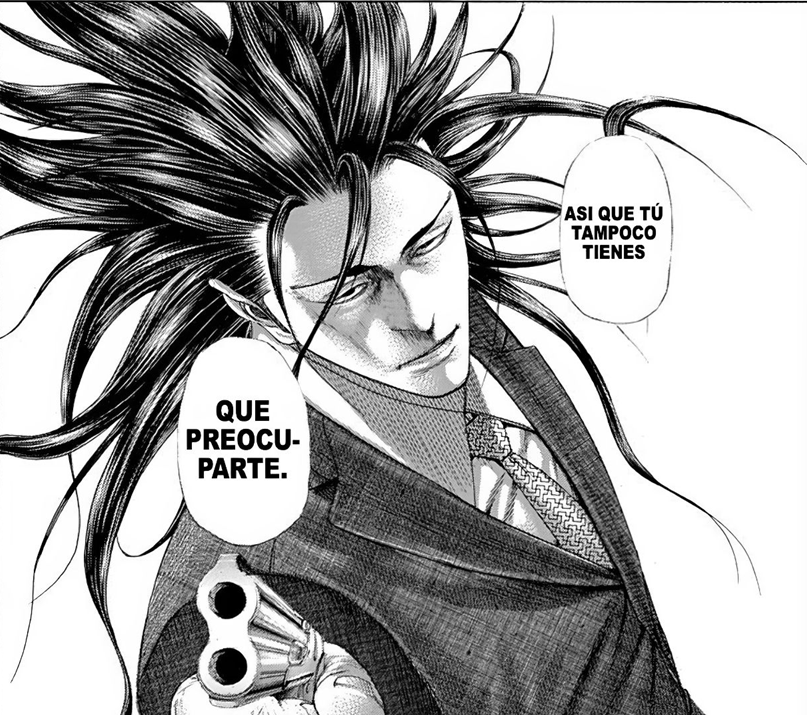
In the Old Testament the word Satan refers to "he who accuses," that individual who is but an extension of God and who is there to act as prosecutor and reveal the truth of those who hide it. It is curious. Now that I write this I remember that in this same volume, Usogui tells Suteguma that he loves hide and seek but more than anything he likes to be the one who seeks. Madarame Baku from the beginning is proposed to us as a character who is there to reveal the lies of his rivals, devour their lies. In this arc, their lies are concentrated in sins, sins that are to be judged. It is not difficult to find in Usogui something of the devil, this is left very clear to us in the manga and more in this volume where panels are shown like that of a Madarame Baku of demonized figure, with a diabolical smile and horns of capri. Let's not forget his complexion, popular culture has known how to confuse the term "Lucifer" as a synonym of the devil, almost always comparing him with the "morning star," an albino and shining figure. An antecedent of this connection we see in Neil Gaiman's Sandman, where the master of hell appears embodied as a handsome and shining young man (inspired by David Bowie by the way). I want to elaborate more on these ideas, because I think that Usogui is not only an isolated symbol of Mediterranean religions, I have been building in my mind a whole symbology referring to divinities and angels. But of that more later. This review has extended too much and the next will probably be equally long.
FAVORITE PANEL: