Review of Vol.22
Usogui's Expression
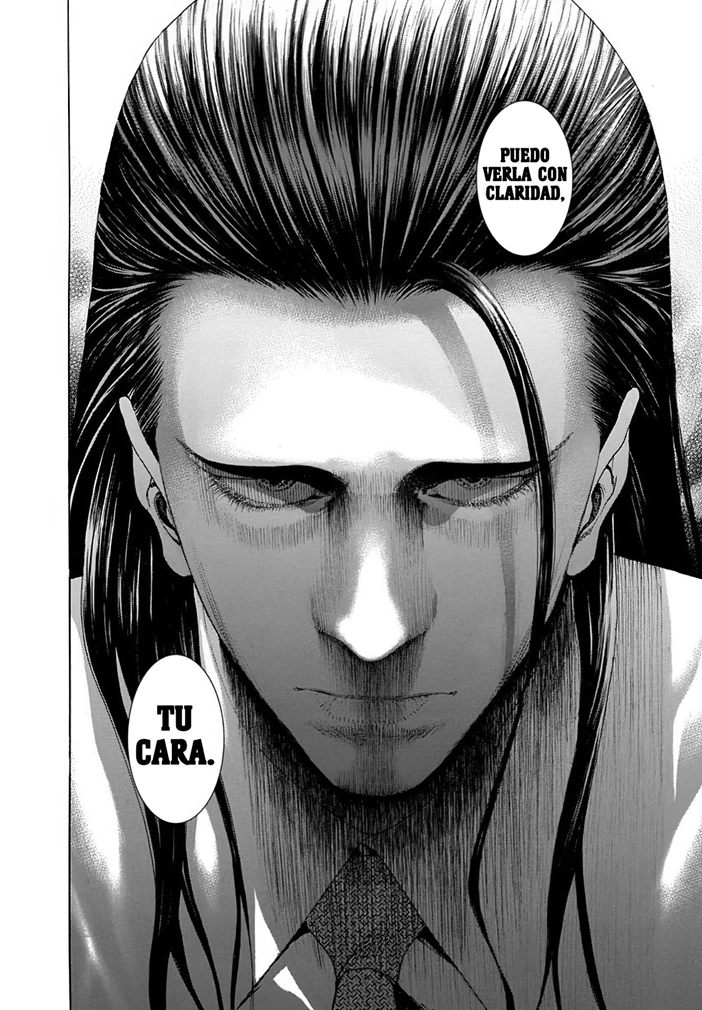
We continue with the result of the second round. Usogui has made a mistake. Now it is Suteguma's turn to ascend the tower, enter the password, and win. Usogui is in danger, apparently in a decisive position. However, a series of comments stops Suteguma in some way: "Up there, you will only find a graveyard". This is not a bluff. Suteguma has every right to think that it is, but for the spectator, it isn't, because it is hinted that something is indeed happening at the top of the Tower of Karma.
Suteguma's Interaction
The volume begins with a proposal: there is nothing up there; accept the third round. Usogui's expression looks deranged. In my opinion, this is the moment where Suteguma's psychology finally opens up to us in this arc. It is the first time we can glimpse his thoughts. Suteguma sees a clear opportunity to learn the password without considering the risks involved: that Usogui might know it and enter it first. Suteguma accepts the 3rd round with a condition that Baku cannot fulfill, so the negotiation ends. The rivals exit the Dotty.
"Knocking on a stone bridge before crossing it."
I want to give Souichi the opportunity to participate in this analysis. Well, I want to pay considerable attention to him since he is the final rival Baku will have in this work, so I want to keep track of him to see if I find something truly interesting. The Commissioner tries to apply a philosophy that, according to him, he has always followed—derived from a Japanese proverb: "tap the stone bridge before crossing it". Besides guaranteeing himself one last chance, the Commissioner chooses to take a route that involves playing with the Leader in his element: a gamble. The result of this bet is significant and remains to be seen. The fundamental thing here is to observe how the Leader "sees through" the Commissioner and extracts his "stone bridge" philosophy. I am eager to see how the idea of the Commissioner's crimes is portrayed, and if this time they will be understood as the atrocities they are, rather than what follows in the next section.
Yakou's Revenge
Here, the idea I glimpsed in the last volume is articulated. The "Karma that fell from the sky" was not enough to make Yakou fall. After a brutal battle, the opponent falls—but not before revealing some aspects of his life. I want to pause here to address the idea of "crime" in this arc. Special emphasis has been placed on the material realities from which some people involved in this game of the Tower of Karma originate, as if it were a kind of "judgment". I am not quite sure if the author wants to "explain" the people playing in this tower through their origins and apply a "Karma" that falls from the sky (the tower) as a way to give an answer to the burden they carry. The introspection given to the "evils" and atrocities committed by the characters in the tower is striking, because in the previous arc, we understood these crimes as reprehensible things that people like Kaji simply could not understand and only knew how to respond to with indignation. Here, I think they are trying to give a more "materialist" look to each context, no matter how involved it is with a crime. I believe the "dance" of the rival along with the brief memories of a tragic life full of unstable conditions is the beginning of a judgment that starts from here for the protagonists. But a single phrase completes my idea about "Karma" in this arc: "Kouhei, it’s not your fault". It is the keyword repeated incessantly in this short flashback. Don't Karma and guilt have something in common? Something elemental? Something that could combine both abstractions and found a framework upon which this entire story could be based? I need to think about what Referee No. 0 says: "What you desired... was it paradise, or nowhere?".
Why did Suteguma accept the third round?
I need to understand Suteguma's position at this exact moment: he knows nothing of Leo or Hyogou, but nothing is known about Marco either. He has a candidate number to enter. But the absence of his companions lets him understand that there is no way to dominate the top of the tower. One last thing triggers his affirmative response: Usogui does not know which was the incorrect entry made by Hyogou. That is what he thinks. And because of that thought—because he believes Usogui cannot go any further—Suteguma challenges Usogui: "Do you really think you can guess correctly?". An old doubt invades me this time: what is this game really about? Is it just luck? Is it just guessing? Is there truly no systematic way to play? Is there really no lie to devour?
"13"
Finally, Marco appears. The digit that was entered by Hyogou is 8, and Marco appears to confirm it. At first, Usogui proves one thing: he can guess correctly. He has "luck". He says "8," to which Suteguma replies: "Splendid". This is done with a very striking condescension. Until this point, Suteguma has barely shown a minimally empathetic side. Now he is open to conversation, especially when it involves showing himself as superior. But his gaze changes when Marco himself appears with the exact same answer. Usogui has proven the second thing: the summit cannot be dominated by Suteguma. Usogui crowns this small victory with one last chance to guess: "The number is 13". And my god, the speech this bastard gives to explain why that number.
Instead of seeing through the enemy, let the enemy see through you.
First, we must clarify the theme of "seeing through" in this arc. This expression is just a parallel to what Baku does every time he devours his rivals' lies. However, since there is no lie to devour here, Baku improvises and inverts the formula. He made Suteguma "see through" him continuously. Suteguma accepts the round because he understood that Usogui truly did not know the incorrectly entered number, and therefore there would be no problem giving him another chance. Usogui's final gesture against Suteguma could be a representation of the statue and the hammer; Usogui "raises and touches" Suteguma's image and then forms the number 8 with his finger. Only then do we see Suteguma tremble for the first time. There is no trick. It is just a defeat.
Suteguma's Past and the forgotten road to immortality
What follows has really left me reeling because of a very enigmatic phrase used only once in this entire arc. I hope this phrase is repeated or at least more information is given so I can complement it and find a fair interpretation. In this section, we are given to understand that Usogui's narration from the previous volume is not entirely incoherent and that Suteguma's life is, in broad strokes, just as Madarame Baku described it. The story of the forgotten road to immortality. Because precisely when Suteguma was 13 years old, he decided to "abandon the abyss". I particularly like the phrase used to explain the context Suteguma comes from, in the chapter titled Haiheizi, which refers to individuals who have not been registered due to the Chinese government's birth policy. Here, the tortuous life Suteguma led from an early age is explained, while the narrator takes the opportunity to explain how "humans are products of their own environment". This has a strong connection to how other characters' pasts are narrated, where, it could be said—as mentioned in this flashback—personalities develop based on the material realities that precede them. This must be some reference to the materialist doctrine that somehow begins to envelop these stories. But let's continue. We are told that Suteguma's past is in every instance abnormal. The abyss in question was nothing more than a "farm" of haiheizi that a politician managed to create—a submissive labor force hidden from the eyes of authority, as these children had no right to be registered or to enjoy a full life. It was not the life of a human; he did not know the semantics of things, nor did he possess the conventional frameworks an infant should have. He was made to know from the start that he did not fall under the denomination of "human". Instead, he was labeled simply as a "living being" and nothing more. A living being with a painful and unreasonable life. Suteguma's story clarifies something: the boy did not leave the abyss because of his suffering, for he knew no antonym to it. He didn't know that one could enjoy well-being. Suteguma understood that the agency he possessed was enough to get out of where he was. Suteguma learned to instrumentalize his thoughts. He understood that it was okay to feel anger. Therefore, he began to liberate himself. It makes me think that Suteguma's story tells how a minimal existence acquires meaning through itself and for itself. There are more nuances that become clear later, such as the idea that Suteguma had learned there was no great dichotomy between his existence and that of others. Once out of the abyss, he had "polished" his existence so that he would no longer doubt. But something is missing. We know the essential content of his characterization: his regained agency. A man formed by a rotten hole permitted by his society. But the story ends with two things: Suteguma left that hole with a will of iron (that is clear in his 28-year-old version), but he was also accompanied by a forgotten road to immortality. I want to believe I’m not obsessing over a meaningless phrase. I need to wait for the end of this arc patiently.
Looking for an end in this tower of karma
The last part of the volume refers to the action occurring in the Tower of Karma—the place where the battles of this arc are fought and an explanation for the doll events is given. First, the mystery of this plan orchestrated by Usogui is opened, for which, honestly, I still don't have enough clues to understand. What is conveyed is the infiltration of IDEAL into the tower and the appearance of a suspicious character who, after a life of crimes, wants to seek "an end in this tower". I am impressed again by the continuous reflections on crime by different criminals throughout the arc. Either way, this review has become giant, so I'll leave it here.
FAVORITE PANEL: